
Begum Akhtar, the ‘Queen of Ghazals,’ Remembered on Her 112th Birth Anniversary Today
Born Akhtari Bai Faizabadi on October 7, 1914, in Faizabad, in present-day Uttar Pradesh, Begum Akhtar became one of the most influential voices in Hindustani light classical music...

Chief Editor
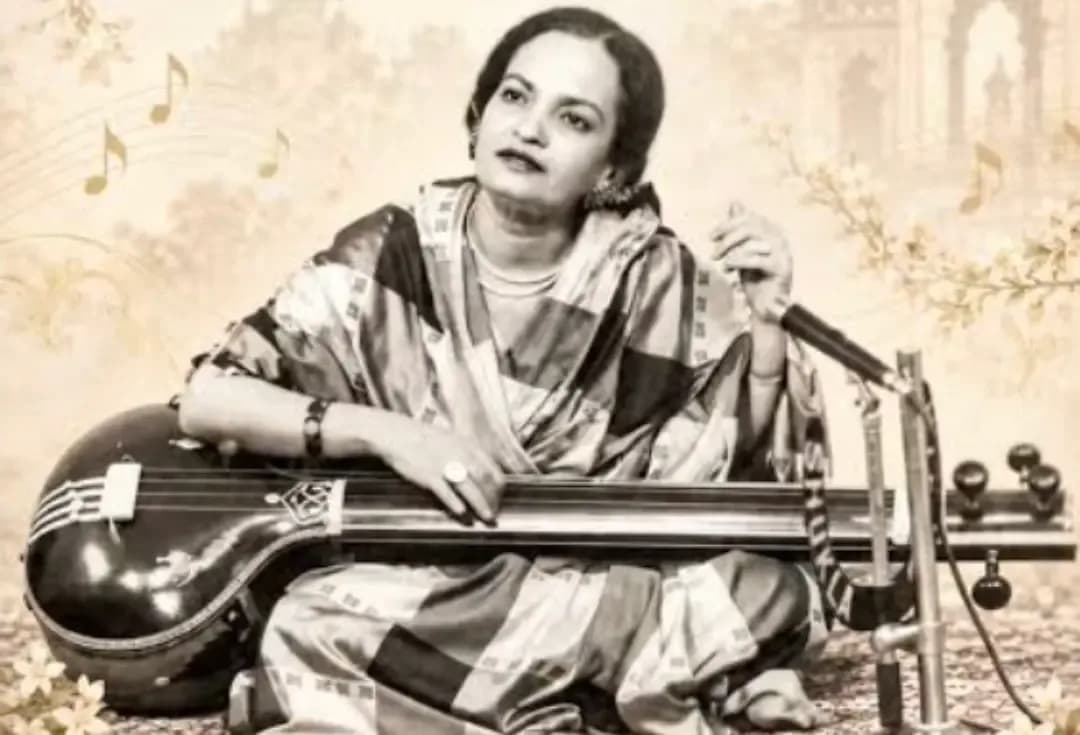
Born Akhtari Bai Faizabadi on October 7, 1914, in Faizabad, in present-day Uttar Pradesh, Begum Akhtar became one of the most influential voices in Hindustani light classical music. Her distinctive style, marked by emotional depth, sophistication and powerful interpretation of poetry, established her as an iconic figure across South Asia.
Born to Asghar Hussain, a lawyer, and Mushtari, a singer and courtesan, she was drawn to music from an early age. She received training from several prominent musicians, including Ustad Imdad Khan, Ata Mohammed Khan of the Patiala gharana and Abdul Wahid Khan of the Kirana gharana.
She began performing publicly at a young age under the name Akhtari Bai Faizabadi. One of her early major breakthroughs came at a 1934 benefit concert held for victims of the Bihar earthquake, where her performance attracted the praise of renowned poet Sarojini Naidu.
Her recording career began in the early 1930s with the Megaphone Company. Her ghazal “Deewana Banana Hai Toh Deewana Bana De,” written by Behzad Lakhnavi, became a major hit and helped establish her as a leading recording artist. Over the course of her career, she recorded nearly 400 songs and became a regular performer on All India Radio.
Begum Akhtar also appeared in several Hindi films during the 1930s and 1940s, including Ek Din Ka Badshah, Nal Damayanti, Mumtaz Begum, Jawani Ka Nasha and Mehboob Khan’s Roti. She later appeared in Satyajit Ray’s acclaimed 1958 film Jalsaghar.
In 1945, she married Lucknow-based barrister Ishtiaq Ahmed Abbasi and became known as Begum Akhtar. Her marriage led to a temporary withdrawal from public singing, but she returned to music around 1949-50 following health problems. Music was reportedly recommended as part of her recovery.
She subsequently resumed her concert career and performed in several countries, including Afghanistan, the Soviet Union and Pakistan. She also trained students in the traditional guru-shishya tradition.
Begum Akhtar was renowned for bringing the emotional intensity and classical sophistication of Hindustani music to the ghazal. She interpreted poetry by celebrated poets including Mirza Ghalib, Mir Taqi Mir, Momin Khan Momin, Shakeel Badayuni, Kaifi Azmi and Jigar Moradabadi.
Among her best-known compositions and renditions are “Ae Mohabbat Tere Anjaam Pe Rona Aaya,” “Woh Jo Hum Mein Tum Mein Qarar Tha,” “Mere Hamnafas Mere Humnawa,” “Deewana Banana Hai Toh Deewana Bana De,” “Ulti Ho Gayeen Sab Tadbeeren” and “Humari Atariya Pe Aao.”
Her contribution to Indian music was recognised with the Padma Shri in 1968 and the Sangeet Natak Akademi Award for vocal music in 1972. She was awarded the Padma Bhushan posthumously in 1975.
Begum Akhtar died of a heart attack in Ahmedabad on October 30, 1974, shortly after a concert. Her final performances included the much-loved ghazal “Ae Mohabbat Tere Anjaam Pe Rona Aaya.” She was buried in Pasand Bagh, Lucknow, beside her mother.
More than five decades after her death, Begum Akhtar's recordings continue to be celebrated by music lovers across South Asia, while her distinctive approach to ghazal singing remains a lasting influence on generations of singers.
Chief Editor
JournalistStaff correspondent covering Culture and national affairs for Pakistan Times Today.

Comments (0)
No comments yet. Be the first to share your thoughts.